Charles R. Moore
Charles R. Moore
Member of the Society of Professional Journalists
Supporter of the SPJ Code of Ethics
Journalism Project
"The people shall not be deprived or abridged of their right to speak, or to publish their sentiments;
and the freedom of the press, as one of the great bulwarks of liberty, shall be inviolable."
~ James Madison

Newsboy on Street Corner, 1909. Photo by Lewis Wickes Hine.
Why?
We are in precarious times in our country. Journalism and journalists have and are being attacked as biased, partisan, and not worthy of belief. Many have been threatened. Powerful people have sown distrust among the public by attacking factual reporting as fake. I am told repeatedly time and time again, often by highly educated people, that the news is not to be trusted and that the truth does not exist. This has resulted in the inability of our country to agree on a common set of facts, resulting in public distrust, unrest, and the decline of support for our newspapers.
Independent, fair, and trustworthy journalism is the foundation of our democracy. To attack the press, sowing mistrust and doubt, is itself an attack on our democracy and, as history has shown, is a precursor to authoritarian rule. One of the most influential books in my life was the authoritative history of Nazi Germany by William Shirer entitled The Rise and Fall of the Third Reich. I read the book when I was in high school in 1965 and it has stayed in my mind ever since. Shirer told the story how Hitler achieved authoritarian rule by the use of the “big lie,” a propaganda technique in which a gross distortion or misrepresentation of the truth was repeated until it was accepted as true, laying the foundation for him to incrementally achieve authoritarian power and eliminate a free and independent press. Because the lies were so extravagant, he concluded, they were more likely to be believed.
The collapse of access to the truth led to oppression, war and atrocities, the extent of which for many are not understood or which they have chosen to forget. I have not forgotten them. For many years the horrors of Nazi concentrations camps were repeatedly shown in black and white film on public television and on other stations at off hours. The films were a warning, seared into my mind and conscience, that humanity, which includes us, is capable of the most horrible acts which, if not guarded against, would one day reappear, even here. I will never forget my children’s babysitter showing me the tattoo on her arm, cataloguing her as a prisoner in a Nazi Concentration Camp. In Hitler’s Germany good people stood by and did nothing to stop his rise to power. I have promised myself that I will not be counted in that number.
Can the Press Be Trusted?
That question has been thrust upon us by those who argue that it should not. Their propaganda has wormed its way into the minds of many Americans, convincing them that the truth does not come from the press but from the charismatic people who seek to lead them.
Of course there should be concern about press credibility. Fox News paid Dominion Voting Systems 787.5 million dollars for wrongfully reporting that their machines were rigged. It is wise to ask ourselves how wide the rot exemplified by Fox has spread.
I have long admired investigative journalists who have committed themselves to ethical and factual reporting, often at great risk to their safety, particularly correspondents in the midst of war and chaos. Investigative journalists have uncovered local and national scandals and have been the trigger for legislation adopted to protect the public from the wrongs and abuse they have uncovered. They do the work which we can apply to keep us free.

Mike Kemp/In Pictures via Getty Images

Journalism Support Fund
Choosing not to stand by and do nothing, I donated $100,000 to the LSU Manship School of Mass Communication which the school named the Charles R. Moore Investigative Journalist Support Fund. There were two clear motives behind this gift:
Encourage students to enter the field of investigative journalism.
Address the loss of public trust in journalism.
My hope was that Manship, as a trusted source, would educate the public that following ethical standards is part of being a journalist and are included in the journalism curriculum. This was to be followed up with research to determine the extent these standards had been adopted and put into practice by news outlets.
The faculty at Manship has done a magnificent job in recruiting nationally known and respected journalists to come to Manship to speak to students in a seminar setting, as well as to meet with the staff of The Reveille, the student newspaper, and to speak to individual classes, giving the students one-on-one access to their experience. The programs to date are set out below.
First Goal: Invite Journalists to Speak at Manship
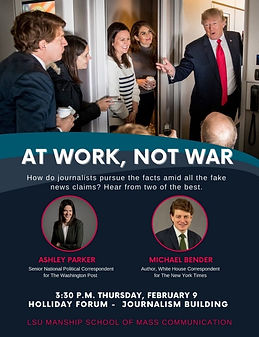
Covering the White House
Ashley Parker, senior political correspondent for the Washington Post, and Michael Bender, White House correspondent for the New York Times and best-selling author, discussed their coverage of the Trump White House. An interesting twist was that they were married, worked for different papers, covered the same stories and were in competition to outdo the other.


Covering the Uvalde School Mass Shooting
Austin-American Statesman reporter Tony Plohetski, and his editor, Manny Garcia, discussed how, using investigative journalism techniques, they exposed as false the official story that the police response to the mass shooting was exemplary.

Covering the World as a Foreign Correspondent
Adam Nossitier, New York Times Pulitzer Prize winning journalist, spoke on being a foreign correspondent in Africa, Europe and Afghanistan where he was bureau chief in Kabul.
Second Goal: Addressing the Loss of Public Trust in Journalism
Independent, fair and trustworthy journalism should be a nonpartisan goal of all Americans. It is part of who we are and what we believe as a nation.
Research is underway on the ethical standards taught in Louisiana Journalism schools and the extent to which those standards are followed in practice in the real world which will likely result in articles made available to the press. The goal is to establish that journalism is a profession which has standards to ensure fair, truthful and trustworthy reporting. As of this writing nothing has been publicly available on this project.
Apart from the Fund at the Manship school, I have been doing my own research on the extent, if any, to which the media has adopted and abides by journalism codes and standards. I was surprised to find that there is a reluctance with many papers to discuss whether they have adopted standards and if so, how the standards are enforced. In light of the attacks on the media and the perception that the media is not trustworthy, I would have thought that the media would have taken steps to affirmatively establish that they are a trusted source for the truth. Almost all of the letters I have written to papers about their standards have never received a response. That will be a story for a later date.
Some papers affirmatively state their standards. In the New York Times you can click on the name of the reporter on the digital version of any story and have immediate access to the reporter’s background and a statement of the ethical standards which that reporter has committed to following. The Times has a thick manual on the standards to be followed in its newsroom which is easily found on the internet at https://www.nytimes.com/editorial-standards/ethical-journalism.html. See also the Washington Post at https://www.washingtonpost.com/policies-and-standards/. The Society of Professional Journalists, which I joined, has adopted a Code of Ethics for its members at https://www.spj.org/ethicscode.asp. This code is often adopted by news organizations. For example, the Bangor Daily News, which in the past had no public reference to any standards, now announces on its website that it follows the Society of Professional Journalists Code of Ethics. The code is set out at the end of this section.
Non-profits are more likely to publicly set out the standards by which they operate. For example, see, ProPublica, Code of Ethics at https://www.spj.org/ethicscode.asp. National Public Radio openly discloses their standards for journalism at https://www.spj.org/ethicscode.asp.The Maine Trust for Local News, a non-profit organization which purchases local newspapers so that Maine communities will not lose their local news, has high standards at https://www.metln.org/our-journalism/ as does the States Newsroom, a non-profit supporting newsrooms in 39 states, including the Louisiana Illuminator: https://statesnewsroom.com/ethics-policy/.
.
What Can be Done to Regain the Public's Trust in Journalism?
Loss of trust in the media will have catastrophic consequences. My donation to LSU was my attempt to help in addressing this loss of trust. My research into the problem will help me better understand the media's response to this attack on their credibility. For example, I do not understand why many news outlets do not disclose the ethical standards, if any, they follow in reporting the news. Some news outlets appear to have concluded that a public commitment to ethical reporting is something that should not be done because it might have an adverse impact on their operation. I look forward to reporting to you on what my research into these issues has found which will be guided by the
Society of Professional Journalists Code of Ethics as set out below: